WildFab: Multi-Axis 3D Printing from Models in the Wild

Jiasheng Qu1, Zhikai Shen1, Chenyu Xu1, Hailin Sun1, Chengkai Dai2, Yuhu Guo3, Junpeng Wang4, Yeung Yam1,2, Guoxin Fang1, 2, *

SIGGRAPH Asia 2026 (ACM Transactions on Graphics)

1The Chinese University of Hong Kong, China.
2Centre for Perceptual and Interactive Intelligence, Hong Kong, China.
3Carnegie Mellon University, USA
4Technical University of Denmark, Denmark
*Corresponding author: guoxinfang@cuhk.edu.hk

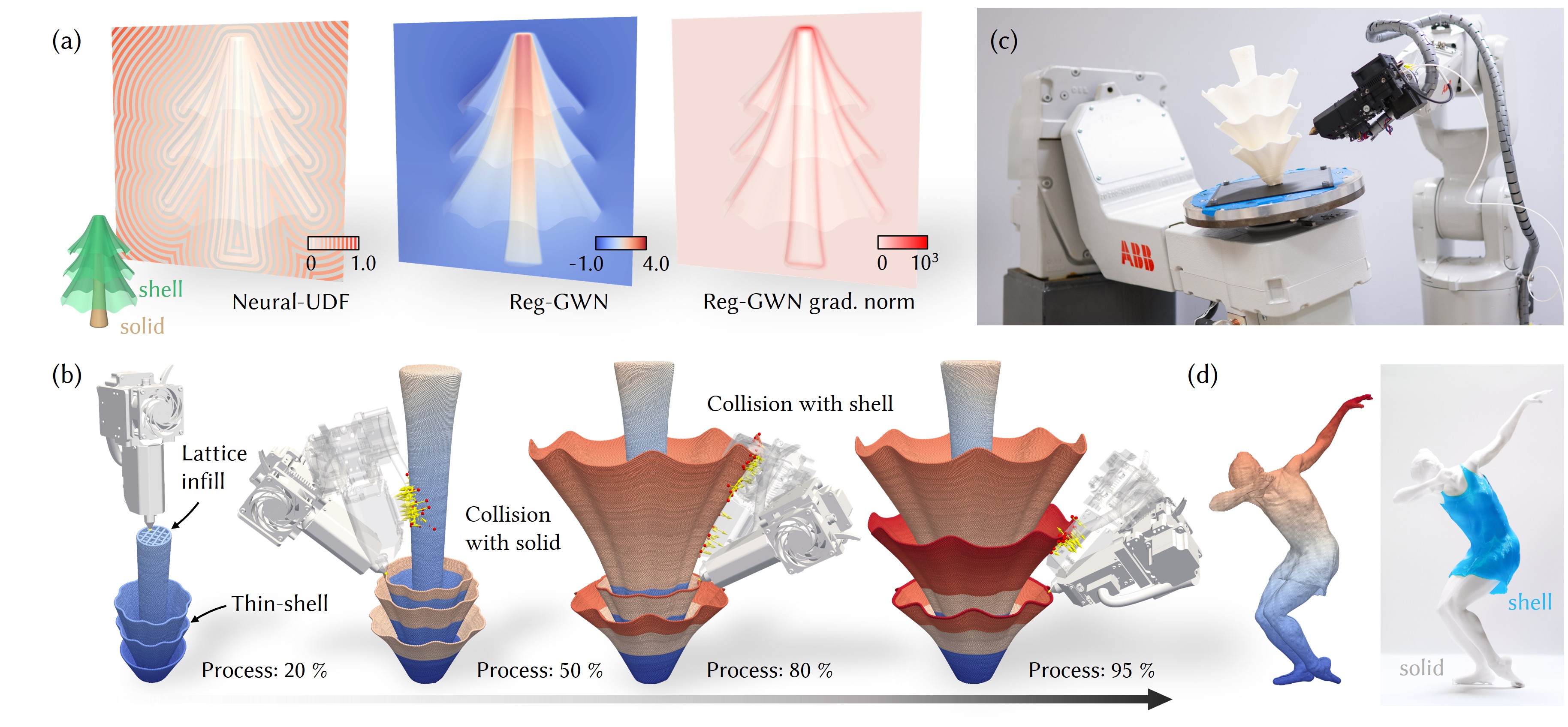
We present WildFab, a computational framework for multi-axis 3D printing that directly generates support-free spatial toolpaths and collision-free robot motions from models in the wild. (a) Input models are represented as hybrid query fields that combine neural unsigned distance and regularized generalized winding number fields. (b) The hybrid representation enables toolpath generation and global collision handling for combined solid-shell structures, supporting (c) successful fabrication with the robotic system. (d) Our pipeline can also generalize to conventional planar-based 3DP, supporting direct toolpath generation for challenging nested and mixed solid-shell models without requiring model repair.

Video Presentation

Hybrid Query Fields: Neural-UDF + Reg-GWN
Directional Weight Score

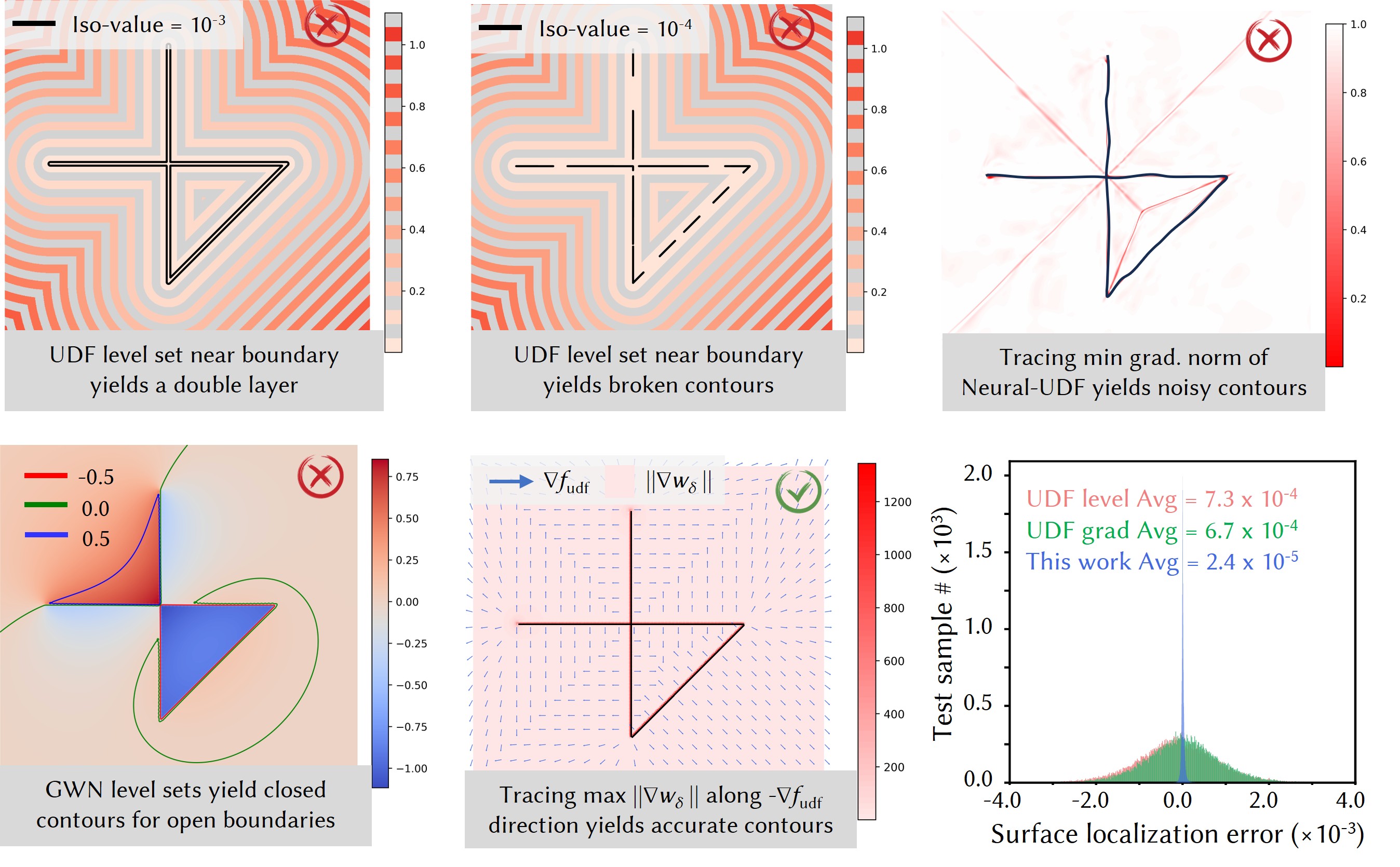
Comparison of boundary detection strategies using neural UDF and reg-GWN fields. UDF level sets and UDF-gradient tracing can fail near boundaries, while reg-GWN level sets can also fail for open boundaries, as illustrated by the 0.5 level set. Tracing the maximum gradient norm of reg-GWN field along the negative neural UDF gradient direction accurately recovers the target boundary, which significantly reduces surface localization error.
WildFab Framework

Directional Weight Score

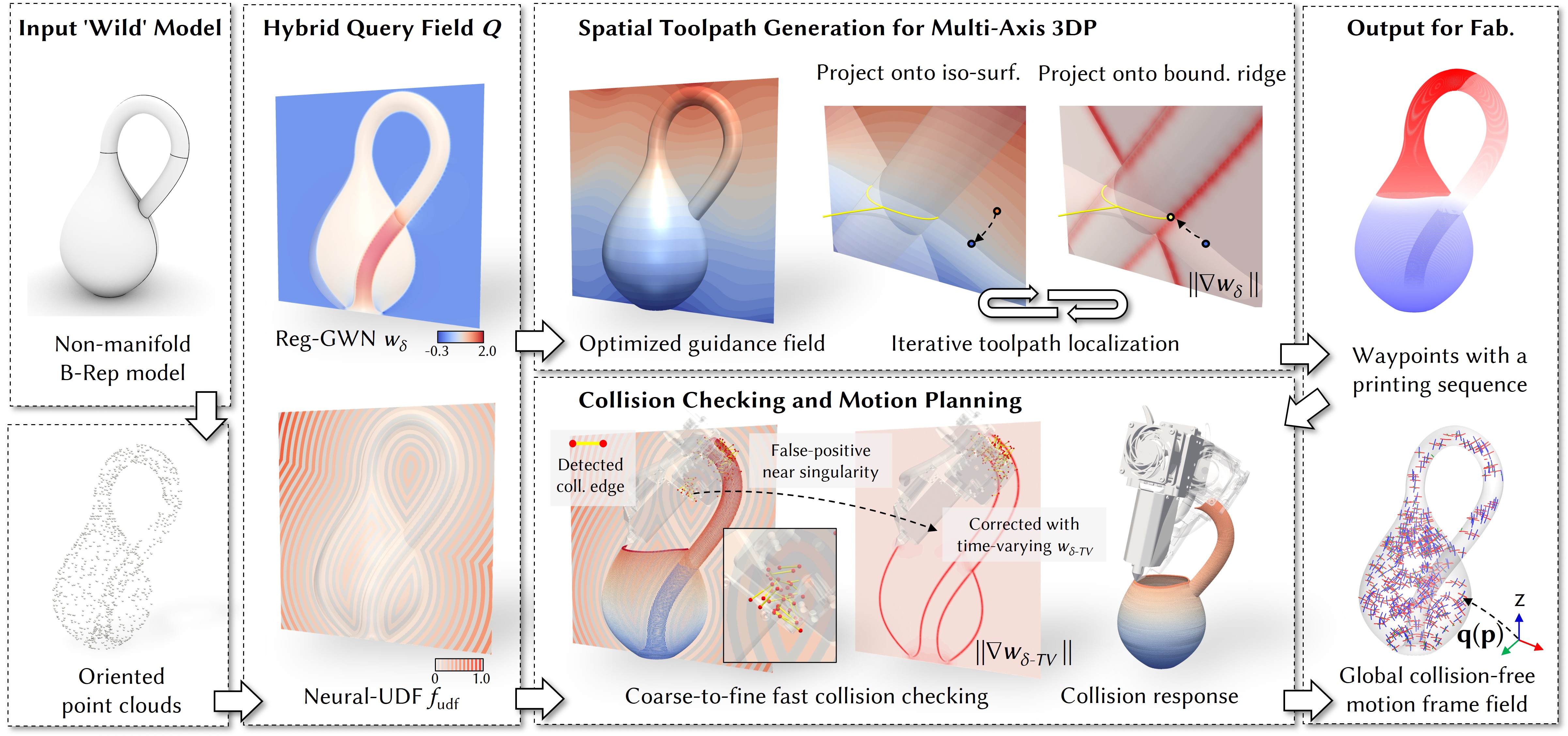
Overview of the proposed computational pipeline. Given an input model in the wild, we first convert it into oriented point clouds and construct a hybrid query field that combines neural-UDF and reg-GWN representations. The query field supports spatial toolpath generation by iteratively projecting waypoints between guidance-field level sets and reg-GWN boundary ridges using the UDF gradient as the search direction. It further enables coarse-to-fine collision checking, where fast UDF filtering and time-varying reg-GWN refinement are used to optimize tool orientations and produce collision-free multi-axis 3D printing motions.

Physical Fabrication

Fabrication Results

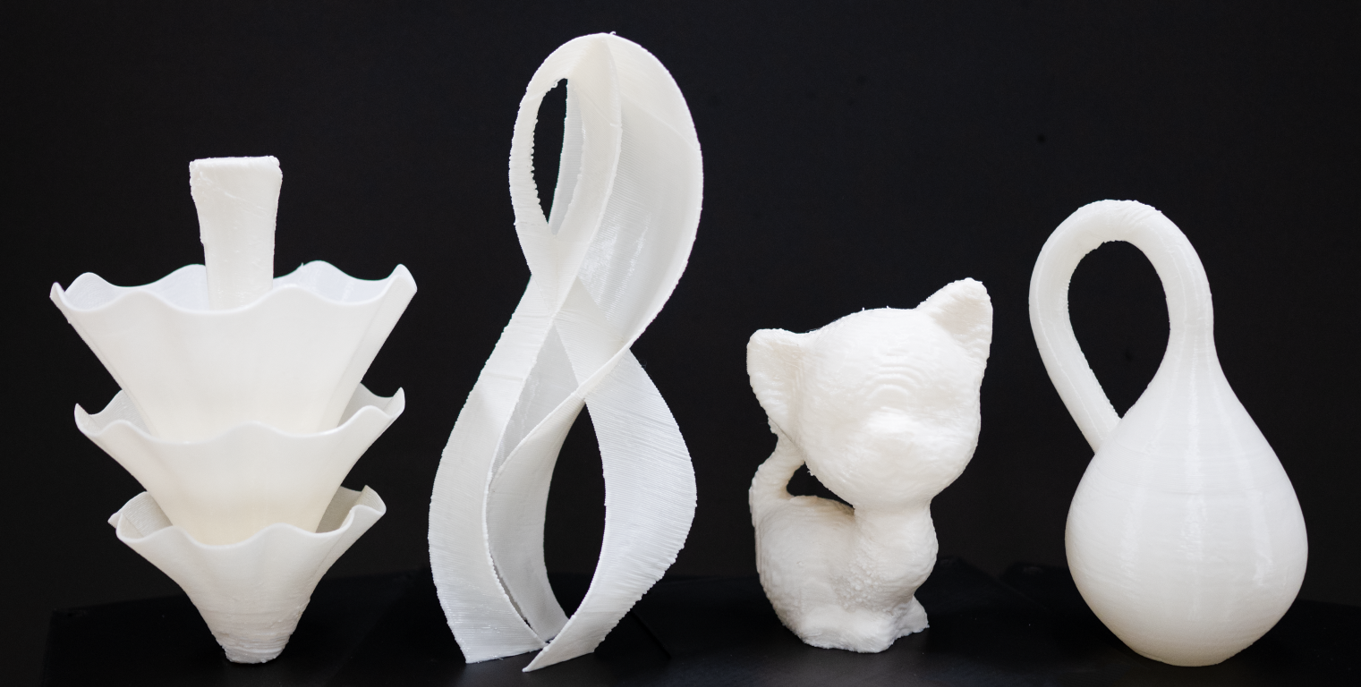
Fabricated WildFab examples

CT Scan Results

Kitten
Klein Bottle

BibTeX


      @article{Qu2026wildfab,
      title={WildFab: Multi-Axis 3D Printing from Models in the Wild},
      author={Qu, Jiasheng and Shen, Zhikai and Xu, Chenyu and Sun, Hailin and Dai, Chengkai and Guo, Yuhu and Wang, Junpeng and Yam, Yeung and Fang, Guoxin},
      journal={ACM Transactions on Graphics (TOG)},
      note={To appear in SIGGRAPH Asia 2026},
      pages={1--19},
      year={2026},
      publisher={ACM}
      }